Signature Picanha
The soul of Brazilian churrasco, by Yohan Attia
Prep time : 20 min · 4 to 6 servings · Resting : 10 to 15 min after cooking
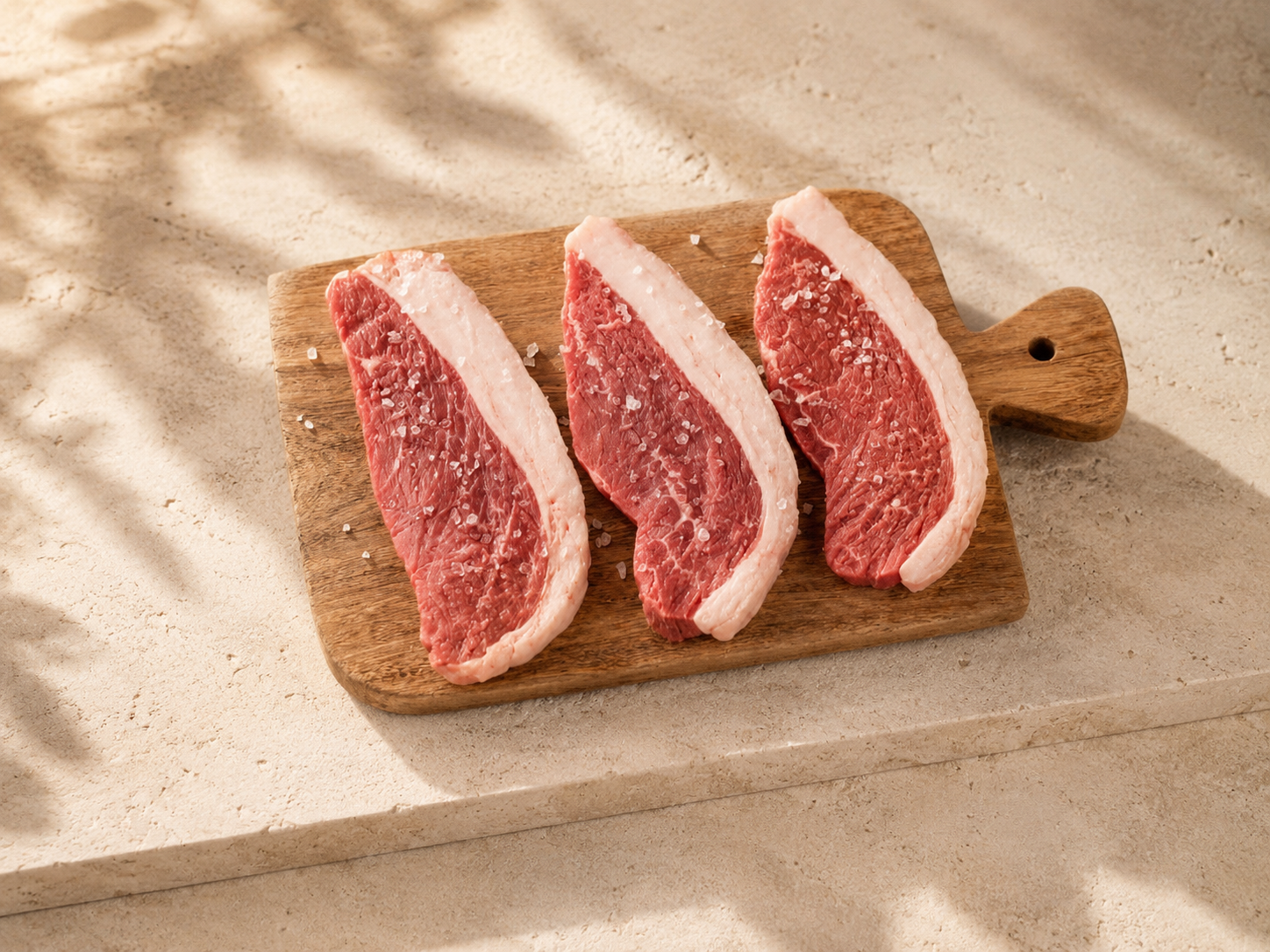
Picanha is one of the emblematic cuts of Brazilian churrasco. Its name comes from the Portuguese "picana", the long metal-tipped pole gauchos used to drive cattle. The cut is instantly recognizable by its thick fat cap on top, which protects the meat as it cooks, slowly renders down and infuses it with that deep, characteristic beef flavor. Anatomically, it is the top of the rump (biceps femoris), a lightly worked muscle that stays naturally tender as long as it is served rare. Long forgotten outside Brazil, picanha is enjoying a real renaissance today, carried by the modern barbecue wave and the contemporary obsession with alternative cuts. Three methods do it justice: roasted whole in the oven, sliced into thick grilled steaks, or skewered churrasco-style.
Ingredients
- Whole picanha: 1 to 1.5 kg with the fat cap intact
- Coarse sea salt (sal grosso or Guérande salt): to taste, applied generously
- Fleur de sel: for finishing
- Freshly ground pepper: optional, only at the end of cooking
- Long metal skewers: 2 to 3 (churrasco method only)
Method
- Choosing and preparing the cut Pick a piece of 1 to 1.5 kg maximum. Anything larger is a "whole rump" that includes other, less tender muscles, often separated by hard fat. The fat cap must be continuous and at least 1 cm thick. Take the meat out of the fridge 1 hour before cooking so it reaches room temperature. Locate the direction of the muscle fibers: they run in a very clear direction — memorize it for the final slicing.
- Trimming and scoring the fat cap Do not remove the fat. If it is thicker than 1.5 cm, thin it down to 1 cm by carefully skimming with a very sharp knife. Then score the fat in a diamond pattern, about 2 cm across, being careful not to cut into the meat. This scoring allows the fat to render gradually during cooking and helps the salt penetrate more evenly.
- Seasoning, the Brazilian way In Brazil, only sal grosso is used: a coarse rock salt applied very generously, without holding back. It partially melts on the surface, forms a savory crust, then gets brushed off before serving to remove the excess. No pepper, no garlic, no herbs: picanha stands on its own. Pepper can optionally be added at the very end of cooking.
- Method 1: whole roast in the oven In a very hot cast-iron pan, sear the picanha fat-side down first for 5 to 7 minutes, until you get a golden, rendered crust. Flip and sear the meat side for 3 minutes. Transfer to a preheated 160°C (320°F) oven, fat facing up, for 20 to 25 minutes. Pull it at an internal temperature of 52°C (125°F) measured with a thermometer: the temperature will rise to 55°C during the rest, for a rare-to-medium-rare center.
- Method 2: thick steaks on the grill Cut the raw picanha into steaks 3 to 4 cm thick, against the grain. Keep the fat cap on each steak. Salt generously 40 minutes before cooking (the salt dissolves, penetrates and seasons deeply) or right before grilling. On a very hot plancha or grill, cook fat-side down first for 4 minutes, then 3 to 4 minutes on the other side. Pull at 52°C (125°F) internal.
- Method 3: churrasco on the skewer Cut the picanha into 3 or 4 thick 3-to-4-cm slices. Thread each slice in a "C" shape onto a long metal skewer, fat facing outward. Salt very generously with sal grosso. Grill over live coals for 15 to 20 minutes, turning regularly. The traditional technique: slice thin ribbons directly off the skewer as the outside cooks, then return the skewer to the fire to keep cooking the center.
- Rest and slicing Whatever the method, let the meat rest for 10 to 15 minutes loosely tented with aluminum foil. This rest lets the juices redistribute and stops them from running out during slicing. Cut perpendicular to the grain, in slices 1 to 1.5 cm thick. A pinch of fleur de sel just before serving, and nothing else.
Chef's tips
- Recognizing a good picanha: the weight must not exceed 1.5 kg. Beyond that, you often get a piece that mixes several muscles, some much firmer than true picanha. The fat cap must be continuous, at least 1 cm thick, and free of hard sinew stuck to the muscle.
- Brazilian salt, the Brazilian way: sal grosso is applied in excess then brushed off before serving. It forms a crunchy crust and never pushes sweetness the way fine salt does. Coarse Guérande salt or fleur de sel are excellent substitutes in France or Israel, where sal grosso remains rare.
- Internal temperature, non-negotiable: picanha is served rare to medium-rare. Pull it at 52°C (125°F) for a rare center, 55°C (131°F) for medium-rare, never past 57°C (135°F). This cut goes dry and tough past 60°C (140°F). A cooking thermometer is not a luxury — it is the only reliable tool.
- Slicing against the grain, obsessively: the muscle fibers on picanha run in a very clear direction. Sliced the wrong way, even perfectly cooked, it turns rubbery and stringy. Locate the grain before cooking, slice perpendicular to it, in thick 1-to-1.5-cm pieces.
- Where to find real picanha: at a standard butcher, it is nearly impossible to find in France. More common in Israel at butchers that specialize in Brazilian or South American meats. Ask for "whole rump cap with the fat": most butchers cut it into smaller pieces by default. A butcher who sells churrasco cuts will know exactly what you mean.
- Aromatic variation, at your discretion: although non-traditional, a touch of confit garlic, fresh rosemary and fleur de sel on the grilled crust at the very end brings an interesting Mediterranean dimension. Add only as a finish, never during cooking, so you don't overpower the personality of the cut.