Upside-Down Apple and Almond Cake
Caramel, ground almonds and whipped Madagascar vanilla cream, by Yohan Attia
Prep time : 40 min · 8 servings (22 cm round tin) · Resting : 15 min before unmolding, plus 12 h of infusion for the vanilla cream
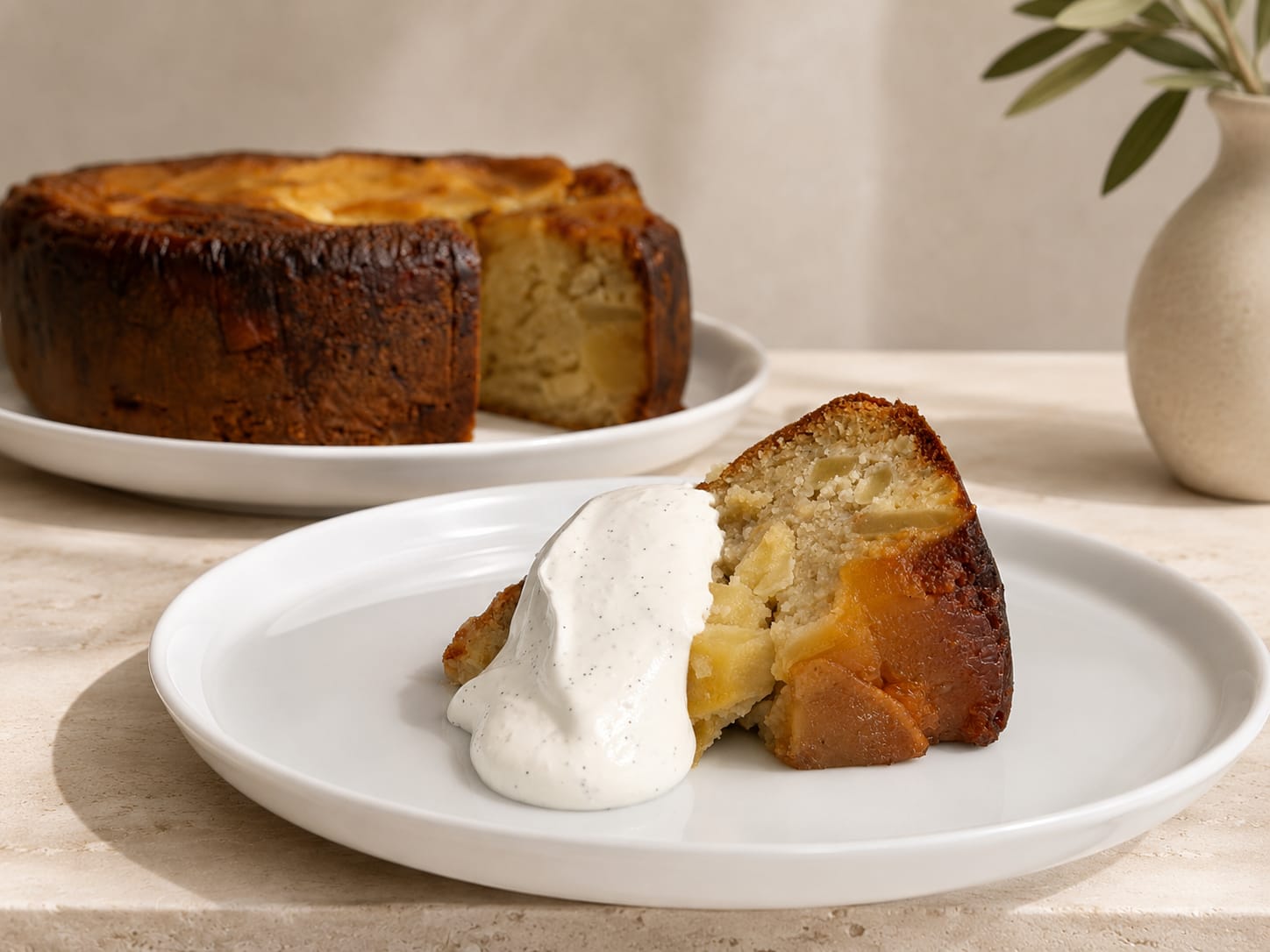
This cake sits between two traditions: the pound cake, dense and moist, and the tarte Tatin, which puts the caramel and the fruit on top. Ground almonds bring the fat and the moisture that keep the crumb tender for three days, yogurt brings the acidity that stops it from being cloying, and melted butter (never creamed) gives it the tight texture of a loaf cake rather than that of a sponge. Two apples in a caramelised rosette on top, two apples in soft cubes inside the crumb. The whipped Madagascar vanilla cream, deliberately left unsweetened, balances the caramel at the table.
Ingredients
- For the caramel
- Sugar: 70 g
- Lemon juice: 1 tsp
- Water: 1 tbsp
- Unsalted butter, diced small, at room temperature: 30 g
- For the rosette
- Firm apples, Golden Delicious or Reinette: 2 medium
- For the batter
- Apples: 2 medium
- Melted butter, lukewarm: 150 g
- Sugar: 140 g
- Eggs: 3 large
- Plain yogurt or crème fraîche: 100 g
- Vanilla extract: 1 tsp
- Ground almonds: 120 g
- All-purpose flour: 130 g
- Baking powder: 8 g (2 tsp)
- Cinnamon: 1/2 tsp
- Fine salt: 2 g
- Flaked almonds, optional: 2 tbsp
- For the whipped Madagascar vanilla cream (unsweetened)
- Heavy cream, 35% fat minimum, very cold: 250 g
- Mascarpone, very cold: 50 g
- Madagascar vanilla pod: 1
- Optional almond cream variation: 50 g soft butter, 50 g sugar, 50 g ground almonds, 1 egg
Method
- The day before: infuse the vanilla Split the Madagascar vanilla pod lengthwise and scrape out the seeds with the tip of a knife. Put seeds and pod into the 250 g of very cold cream, cover with film and let infuse for 12 hours in the fridge. Since the cream is whipped without sugar, this long cold infusion is what carries all the flavour. Quick version: heat the cream to 70 °C with the vanilla, let it cool, then chill for at least 4 hours.
- Preheat and prepare the tin Preheat the oven to 180 °C fan. Line the base of a 22 cm round tin with parchment paper and butter the sides. If your tin is springform, wrap it in aluminium foil: the caramel is liquid at first and leaks through the seam.
- The caramel, judged by eye and nose In a small saucepan, combine the sugar, lemon juice and water. Heat over medium heat and never stir with a spoon: only swirl the pan with a flick of the wrist. The syrup stays clear and runny for a long time, which is normal, and the colour arrives all at once at the end. From the first golden patches at the edges, count 30 to 60 seconds maximum. At light copper amber and the smell of toasted hazelnut, take it off the heat immediately. The reliable marker is colour and smell, not a thermometer reading.
- The butter in the caramel Off the heat, add the diced butter, at room temperature and never straight from the fridge, in two or three additions, whisking right away. The butter stops the sugar from cooking further. Pour immediately into the tin and tilt it to spread the caramel over the whole base. If a film of yellow oil floats on top, the emulsion has broken: put it back on very low heat and whisk hard, adding a tablespoon of hot cream if needed.
- Arrange the apple rosette Peel the 2 apples for the rosette, cut them into quarters, remove the core, then slice them evenly at 4 mm. Arrange them in a tight rosette over the caramel, overlapping slightly. This is the face that ends up on top after unmolding, so it deserves care.
- The diced apples Peel the 2 remaining apples and cut them into cubes of about 1.5 cm. Smaller and they vanish into the crumb; larger and they release too much water and sink the cake. Set aside.
- Make the batter Whisk the eggs with the sugar for 2 to 3 minutes, until the mixture pales and doubles in volume. Add the lukewarm melted butter (not hot, it would cook the eggs), the yogurt and the vanilla, then whisk for another 30 seconds. The butter is melted, not creamed: that is what gives the dense, moist loaf-cake texture rather than an airy sponge.
- Fold in the dry ingredients Mix the ground almonds, flour, baking powder, cinnamon and salt separately. Pour over the batter and fold with a spatula, stopping as soon as the flour has disappeared. Do not work the batter beyond that: the gluten would develop and the crumb would turn rubbery instead of staying tender.
- Add the apples and pour Gently fold the diced apples into the batter. Pour the batter over the rosette without disturbing it, starting from the centre, smooth the top and scatter the flaked almonds if using. For the almond cream variation, spread it over the rosette just before pouring the batter.
- Bake Bake for 50 minutes at 180 °C. A knife inserted in the centre should come out clean. If the top colours too fast after 30 minutes, cover loosely with a sheet of aluminium foil.
- Rest 15 minutes, then unmold Let it cool for exactly 15 minutes, timed. Any earlier and the still-fragile cake breaks; any later and the caramel sets and sticks to the base of the tin. Run a thin blade around the edges, place the serving plate over the tin and flip it over in one sharp, decisive move. Peel off the parchment paper.
- The unsweetened whipped vanilla cream Strain the infused cream to remove the pod. Pour it with the mascarpone into a well-chilled bowl (bowl and whisk 15 minutes in the freezer) and whip at medium speed. Stop at soft peaks, when the cream forms a ribbon that slowly folds back on itself: without sugar it is less stable and turns grainy if you over-whip it. Whip it at the last minute and serve it as a quenelle on a still-warm slice. The contrast between the warm caramel and the cold unsweetened cream is the whole point.
Chef's tips
- Caramel is judged by eye and nose, not with an infrared thermometer. An IR gun reads the surface of the syrup, which evaporation keeps cooler, and shiny sugar reflects the radiation of the room: you can read 15 to 30 °C below reality. If you want a number, aim for 170 to 175 °C with an immersion probe placed in the middle of the liquid, not touching the bottom of the pan, otherwise you are measuring the metal. The real marker stays light copper amber and the smell of toasted hazelnut.
- Stop the caramel earlier than you think. It keeps cooking for 50 minutes under the apples in the oven. A caramel already dark brown when it leaves the pan comes out bitter in the finished cake.
- Butter that splits in the caramel is not a failure, it is a broken emulsion: butter holds around 16% water, it flashes into steam and the fat separates on top. Three causes, often combined: butter straight from the fridge, added in one block, or whisked too late. Fix: very low heat and vigorous whisking, then a tablespoon of hot cream or boiling water if it resists. And if the emulsion refuses to come back, pour it into the tin anyway: the butter migrates into the apples while baking and nothing shows after unmolding.
- The choice of apple matters a lot. Golden Delicious and Reinette hold up to baking and stay meltingly soft. Avoid Granny Smith for the rosette, it releases too much water and washes out the caramel.
- The 15 minutes of resting before flipping are not approximate. Too early and the still-fragile cake breaks. Too late and the cooled caramel sticks to the base, leaving the rosette in the tin.
- Unsweetened cream must be whipped at the very last minute. Sugar stabilises as much as it sweetens: without it, the cream collapses within one to two hours. Everything must be very cold, and the 50 g of mascarpone add hold without touching the flavour. Stop at soft peaks, never firm.
- Parve version (dairy-free, meat-meal friendly): pastry margarine or deodorised coconut oil instead of butter, soy yogurt or unsweetened apple purée instead of yogurt. For the cream, a coconut-based whipping cream, infused the same way. The softness holds thanks to the ground almonds.
- Almond cream variation, to push the almond all the way: spread a thin layer of almond cream (50 g soft butter, 50 g sugar, 50 g ground almonds, 1 egg) directly over the rosette before pouring the batter. You get a soft frangipane layer between the apples and the cake, spectacular when sliced.
- Storage: 3 days under a cloche at room temperature, never in the fridge, which hardens the caramel and dries the crumb. The cake is better the next day, once the moisture from the apples has finished spreading.