Signature Chocolate Babka
From Poland to Tel Aviv, by Yohan Attia
Prep time : 45 min · 1 large babka · Resting : 12 hours minimum (ideally 24 h)
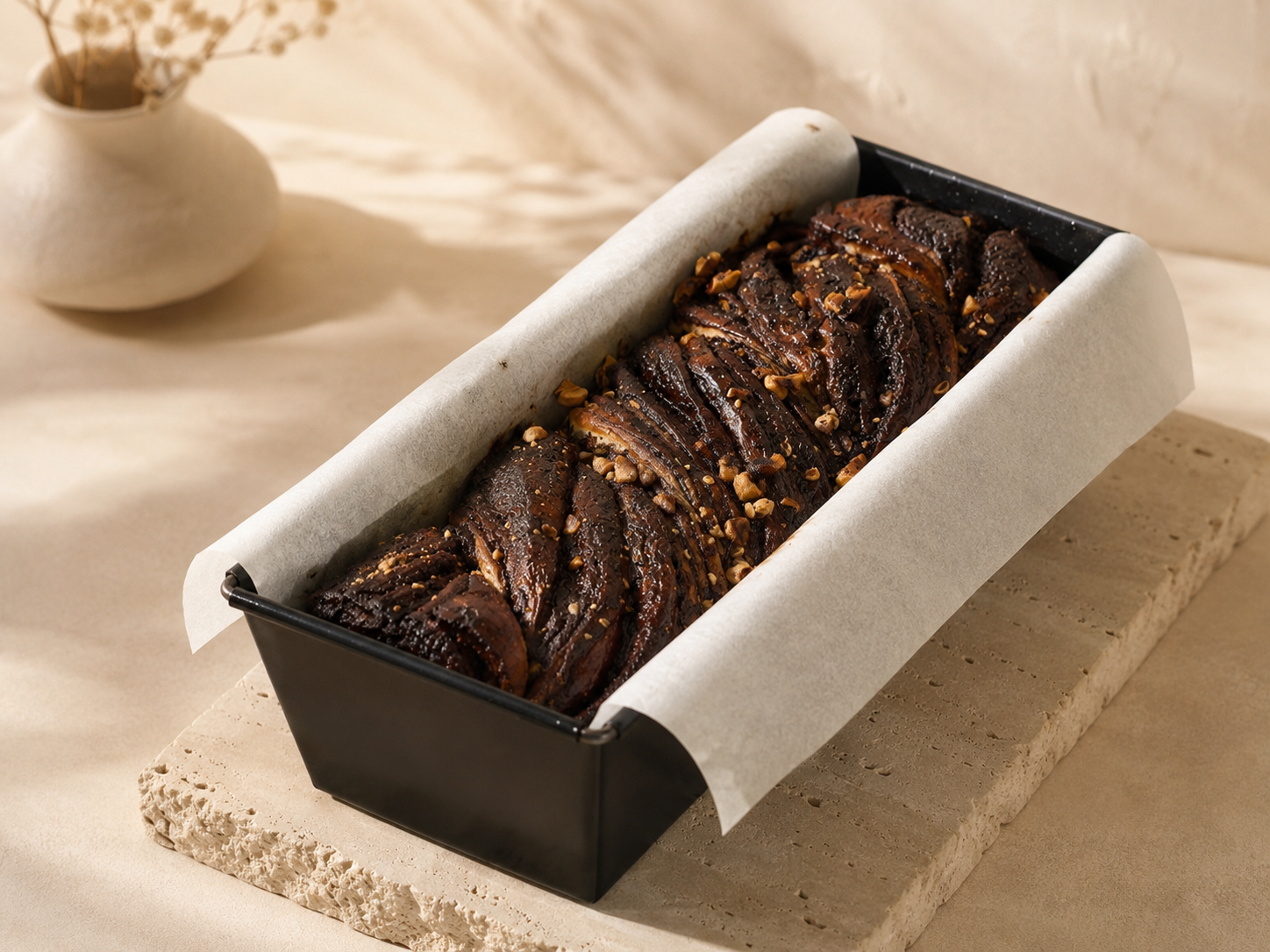
Born in the Jewish kitchens of Eastern Europe, babka — whose name means "little grandmother" in Polish — is a braided brioche wrapped around a chocolate filling. Long made from leftover challah dough, it found its modern form in the Jewish bakeries of Brooklyn, then in Tel Aviv, where it became a true institution. The secret of an exceptional babka comes down to three words: slow fermentation, generous butter, tight braiding. The cold proof of at least 12 hours is not optional — it is what gives the crumb its stretchy texture and complex flavor.
Ingredients
- For the brioche dough
- Flour (T45 or T55 / all-purpose): 500 g
- Sugar: 80 g
- Salt: 10 g
- Active dry yeast: 10 g (or fresh yeast: 25 g)
- Eggs: 3
- Lukewarm milk: 120 g
- Soft unsalted butter: 150 g
- For the chocolate filling
- Dark chocolate 60%: 180 g
- Butter: 120 g
- Icing sugar: 80 g
- Unsweetened cocoa: 30 g
- Fleur de sel: 1 pinch
- For the syrup
- Sugar: 80 g
- Water: 80 g
- Parve variation (dairy-free, Shabbat & meat-friendly): replace the milk with water or unsweetened soy milk, the brioche butter with a neutral oil (sunflower, grapeseed), and the filling butter with a quality pastry margarine.
Method
- Kneading and developing the gluten In the bowl of a stand mixer, add the flour, sugar, salt and yeast. Add the eggs and the lukewarm milk. Knead on medium speed for 8 to 10 minutes, until the dough pulls away from the sides and becomes smooth and elastic.
- Working in the butter Add the soft butter in several additions, piece by piece, without rushing. Wait for each addition to be absorbed before adding the next. Keep kneading for another 8 to 10 minutes until the dough is perfectly smooth, glossy and elastic, and pulls away completely from the bowl.
- Slow cold fermentation Cover the dough with plastic wrap and refrigerate for a minimum of 12 hours, ideally 24 hours. This slow cold proof is non-negotiable: it develops the aromas, structures the gluten, and makes the dough easy to roll out the next day.
- The chocolate filling Melt the dark chocolate and butter in a double boiler or in the microwave in short bursts. Off the heat, stir in the icing sugar, the sifted cocoa and the pinch of fleur de sel. Mix until you get a smooth, spreadable paste. If it is too runny, let it cool for a few minutes; if too firm, warm it very slightly.
- Shaping and braiding Roll out the cold dough into a large rectangle of about 40 x 30 cm on a lightly floured surface. Spread the filling generously over the whole surface, leaving a 1 cm border. Roll the dough up tightly lengthwise. Cut the log in half lengthwise, filling facing up, then braid the two strands keeping the chocolate visible. Place in a greased loaf pan lined with parchment paper.
- Second proof, baking and syrup Let it rise at room temperature for 1 to 1.5 hours, until the babka has almost doubled in volume. Bake at 170°C (340°F) for 35 to 45 minutes, until deeply golden. Meanwhile, bring the sugar and water to a boil for the syrup. As soon as the babka comes out of the oven, immediately pour the hot syrup over it while still piping hot. Let cool completely in the pan before unmolding.
Chef's tips
- Long fermentation, the real secret: 12 hours is a minimum, 24 hours gives the best result. The dough develops complex aromas, gains structure, and becomes far easier to handle when cold. No shortcut possible.
- Quality butter changes everything: choose an AOP butter, at least 82% fat, at room temperature but not melted. The amount looks high, and that's normal: it is what gives the babka its stretchy crumb and signature melt-in-the-mouth texture.
- Braiding, chocolate facing up: once the log is cut in half, always keep the chocolate side exposed while braiding. This is what creates that spectacular marbled pattern when sliced, the visual signature of bakery babkas.
- Syrup, hot on a hot babka: the syrup must be poured immediately out of the oven, over the still-burning babka. The heat allows fast absorption that moistens the crumb, intensifies the sweetness and gives a flawless shine. Don't skip it — it is what keeps the babka fresh for 3 days instead of one.
- Shabbat variation (parve): the dairy-free version lets you serve the babka with a meat meal. Quality margarine and neutral oil give a result very close to the butter version. For an exceptional Saturday-night dessert.
- Storage: under a cloche or plastic wrap at room temperature for 2 to 3 days. The babka can be frozen whole (tightly wrapped) for up to 1 month. Thaw slowly in the fridge, then 5 minutes at 150°C (300°F) to bring back the softness.